What Is Probiotic Tea? A Guide to Fermented Tea Leaves (Beyond Kombucha)
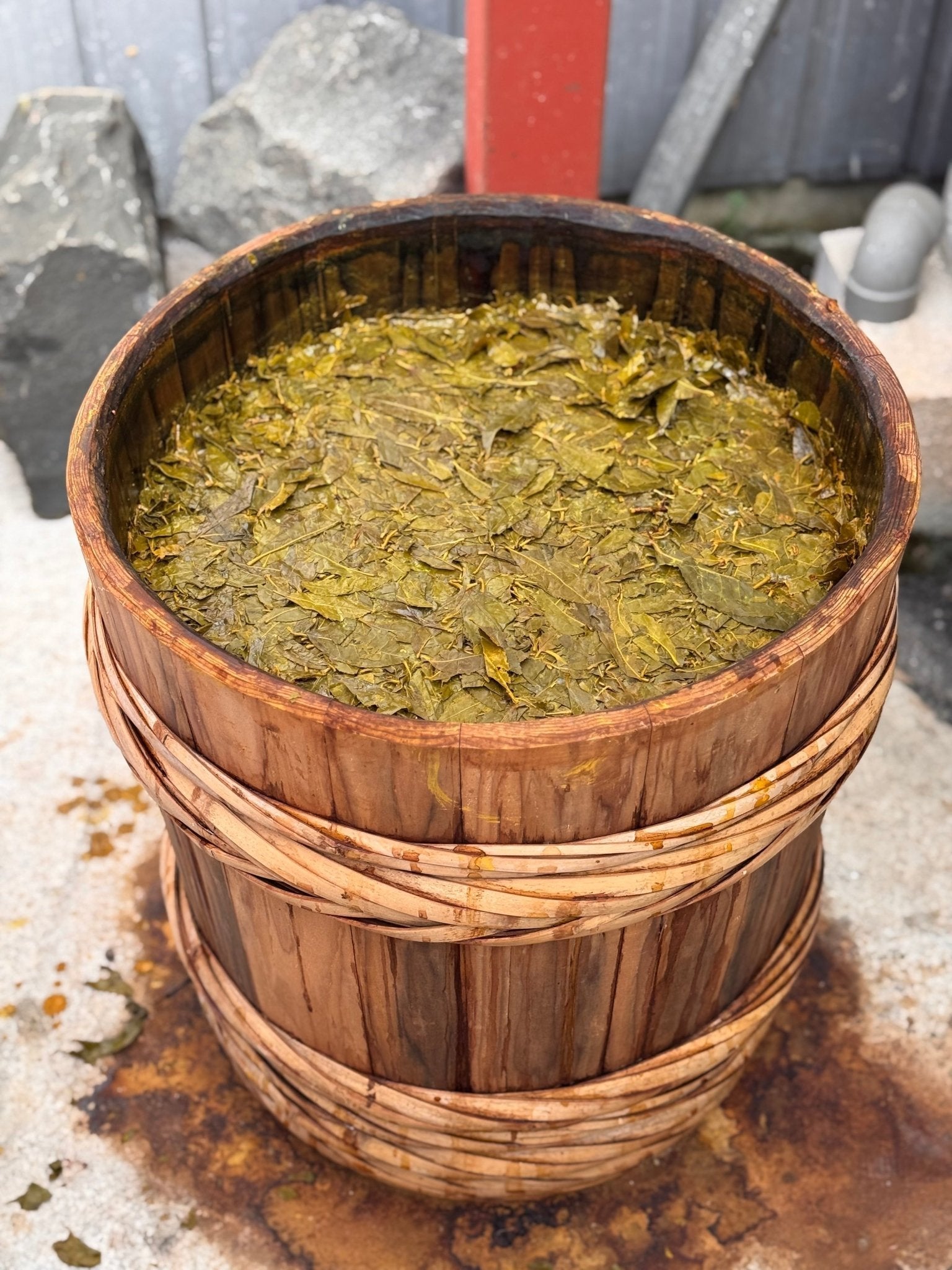
Awa Bancha · Goishi-cha · Ishizuchi-san Kurocha · Myanmar Lahpet · Yunnan Suancha
Welcome to a tea universe that most people don't reach. It is populated by large, heterogeneous, course leaves and an insane collection of (friendly) microorganisms. Many of these teas are genuinely rare, with sweet and sour tasting notes that are reminiscent of fruit. They are anaerobically fermented teas: fermented in absence of oxygen by a wild ecosystem of lactic acid bacteria. Some people attribute a long list of heatlh benefits to these leaves; we can safely claim that many of these teas are delicious. And you're always welcome to our tea bar to try them.

Our team is familiar with five living traditions of anaerobically fermented tea; there are, most likely, several others that we haven't encountered.
In Japan, the island of Shikoku is home to Awa Bancha (阿波晩茶) from Tokushima, Goishi-cha (碁石茶) from Kochi, and Ishizuchi-san Kurocha (石鎚黒茶) from Ehime. Lahpet (လက်ဖက်) is a most interesting pickled tea of Myanmar that is more often eaten than drunk. The (not very creatively named) Suancha (酸茶, 'sour tea') is a specialty of the De’ang and Bulang peoples of western Yunnan.
Worth noting before we go further: Goishi-cha and Ishizuchi-san Kurocha aren't purely anaerobic — they start with an aerobic pile fermentation, like cooked pu er, before going into the barrel.
Fermented Probiotic Loose Leaf Teas
| Tea | Region | Leaf type | Fermentation mode | Heritage status |
|---|---|---|---|---|
| Awa Bancha (阿波晩茶) | Tokushima, Japan (Shikoku) | C. sinensis var. sinensis; yamacha + Yabukita | Single-stage anaerobic (LAB only) | Important Intangible Folk Cultural Property, 2021 |
| Goishi-cha (碁石茶) | &Otoyo;-chō, Kōchi, Japan | C. sinensis var. sinensis; yamacha + Yabukita | Two-stage: aerobic mould → anaerobic LAB | Important Intangible Folk Cultural Property, 2026 |
| Ishizuchi-san Kurocha (石鎚黒茶) | Saijō, Ehime, Japan | C. sinensis var. sinensis | Two-stage: aerobic mould → anaerobic LAB | Important Intangible Folk Cultural Property, 2023 |
| Lahpet (လက်ဖက်) | Shan State, Myanmar | C. sinensis var. assamica (large-leaf) | Single-stage anaerobic (LAB; pits / sealed sacks) | UNESCO ICH submission, 2026 |
| Suancha (酸茶) | Yunnan, PRC (De’ang & Bulang) | C. sinensis var. assamica | Single-stage anaerobic (LAB; bamboo tubes / pits) | PRC ICH VIII-268, 2021; UNESCO 2022 (sub-item) |
Table 1. Sources: Japanese Agency for Cultural Affairs national database;1,16,26 PRC ICH database;43 Mekong Tourism Organisation.42
Awa Bancha (阿波晩茶) — Tokushima, Japan
Awa Bancha is produced in the mountainous interior of Tokushima Prefecture, in and around Kamikatsu (上勝町), the Naka River valley, and Minami Town. Local lore ties its origin story to the Buddhist monk Kobo Daishi (aka Ku Kai, 空海, 774–835 CE), founder of the Shingon school, who is said to have brought tea seeds back from Tang-dynasty China and introduced the technique of fermenting boiled leaves in wooden vessels. We have found no documents that prove or disprove this story.
We can, however, quote the 1882 Tokushima Prefecture Statistical Table (明治15年 徳島県統計表), which records bancha production at approximately 284 metric tonnes — nearly double that of green tea in the same year. Whereas modern Japanese folks drink predominantly green tea, Tokushima's traditional bancha seems to have been the drink of the people back in the day!
By the early 2000s, Awa Bancha was considered a regional relic, mostly consumed by old folks in the villages. There are, fortunately, many people working to preserve this wonderful tea these days. The Japanese government, in 2021, designated the manufacturing technique as a National Important Intangible Folk Cultural Property (重要無形民俗文化財). Our old friends Ikawa (in Naka) and Kana and Sil (in Kamikatsu) are some of the young folks sharing Awa Bancha with the world.
In Shizuoka, the Tatara family and the Bancha Research Association are working hard to preserve old tea recipes from Japan. Tatara San uses heirloom leaves from Shizuoka to create some really delicious 'Awa Bancha Style' fermented tea.


Awa Bancha's production zones sit within evergreen forests. Tea is usually made in the middle of summer, when heat and humidity feel overwhelming to most modern urban folks. These conditions strongly favour lactic acid bacteria proliferation.
The kill-green step involves boiling the leaves. In Kamikatsu, producers then rub the leaves by hand in a boat-shaped wooden trough called a cha-suri-bune (茶摺り舟). In the Naka valley, a motorised kneading machine handles this step, and boiling often continues for up to twenty minutes over wood-fired cauldrons fed by spring water.
The rubbed leaves are packed into wooden barrels (oke, 桶); some younger producers use food grade plastic tubs. The mass is trampled to expel air, sealed with 'basho' (a type of banana) leaves, weighted with stones, and flooded with the parboiling liquor. No starter culture is added. The bacteria driving fermentation live in the barrel walls themselves, in the leaves, and in the room.4 After 10 days to four weeks, the liquid is drained and the leaves are sun-dried for two to three days on straw mats.1

Since every granny that we know has her own recipe of Awa Bancha, we tend to take most articles as a valid representation of the tea samples in question - but probably not of the whole Awa Bancha universe.
We found the following interesting: most spontaneous lactic fermentations of plant matter are dominated by Lactiplantibacillus plantarum — a workhorse species found in kimchi and sauerkraut. Awa Bancha (in this article), tends to be rich in Lactiplantibacillus pentosus. Source: Nishioka and colleagues, who found that three of the four samples ielded almost exclusively L. pentosus and one had a mixed community.3,4
Why L. pentosus rather than L. plantarum? A 2019 regional comparison by Horie and colleagues pointed to the presence or absence of an aerobic mould phase as the key ecological selector: two-stage teas like Ishizuchi Kurocha, which have a mould phase, are dominated by L. plantarum; single-stage Awa Bancha is dominated by L. pentosus.11
A 2025 study from the same group formalised the mechanism: catechins and lactic acid produced during an aerobic phase jointly select for L. plantarum over L. pentosus — and since Awa Bancha has no aerobic phase, that selection pressure simply doesn’t apply.66
The barrel itself matters enormously. Producers’ barrels are demonstrably distinct from one another at the strain level — each barrel is its own microbial terroir, maintained year after year without any starter culture.4

Chemistry - Rich in GABA and Lactic Acid
The samples of Awa Bancha tested in the following research contained 0.4–3.8 g lactic acid per 100 g dry leaf (higher values from Naka producers), and GABA ranges from 2.2 to 80.5 mg per 100 g — at the upper end comparable to the highest naturally fermented foods.3,56
Goishi-cha (碁石茶) — Kochi, Japan
Goishi-cha is produced in the mountainous interior of Otoyo (大豊町), Kochi Prefecture. The name comes from the shape of the little 'tea cakes' which resemble the 'stones' (ishi) used in a game of Go. Locally (and unappealingly) the tea was also known as uma no kuso-cha “horse-dung tea”. What a disservice to this wonderful tea!16
The oldest surviving text using the two characters 碁石茶 appears in the a regional geographical compendium dated 1746. The tea may go back further still, but we have no data about its shape, flavour or handcrafting process.

From at least the eighteenth century through the Meiji era, goishi-cha was produced for the salt-barter trade with the Seto Inland Sea islands. Boats from Naoshima and Awaji brought salt up the Yoshino River to Otoyo; and took back goishi-cha. On those salt-producing islands, where fresh water was brackish, goishi-cha became the base forchagayu (茶粥) — a tea-cooked rice porridge whose acidity and lactic character were thought to counteract the saline water.16
At its height — the Taisho era, 1912–1926 — hundreds of farming households participated in production. Like many of Japan's wonderful regional specialties, the postwar era plunged the production of this tea into sharp decline. The reasons: convergence of rural depopulation, the spread of sencha, and the abandonment of chagayu. Encouragingly, the Goishi-cha Cooperative was founded around 2010, with seventh-generation producer Ogasawara San at its centre. The cooperative loans the Ogasawara family’s century-old barrels and mushiro mats to member producers each season — because those barrels carry the house mould community, the microbial heritage of the tradition.17 In 2026, goishi-cha was formally designated a National Important Intangible Folk Cultural Property.

The production season runs June to August, requiring several consecutive sunny days for the final drying. The total process takes about sixty days.
After harvest by sickle — uniquely, both mature and newly grown leaves are taken without discrimination — the branches are steamed for one to two hours in a wooden bucket. This inactivates leaf oxidases, softens cell walls, and produces the mushijiru (蒸し汁) steam condensate that is reserved for the second fermentation stage. The stripped leaves are spread fifty to seventy centimetres deep on mushiro mats on the earthen floor of the muro (室, fermentation room) for seven to ten days. The muro and its mats host indigenous mould communities — principally Aspergillus, Penicillium, and Mucor — that proliferate over the leaves, degrading cell walls, hydrolysing gallate-type catechins to free EGC and gallic acid, and heating the pile internally.13,23
The mould-covered leaves are then transferred into wooden kioke (木桶) barrels — some over a century old — and the reserved mushijiru is poured over them. A wooden lid is weighted with heavy stones; during fermentation, gas production visibly lifts the lid assembly. In this oxygen-free environment, lactic acid bacteria — predominantly Lactiplantibacillus plantarum — take over.21,13 After ten to twenty days, the compressed mass is extracted, cut into squares, and sun-dried on mushiro for two to three days.

No surprise! Some Aspergillus (the same family found in Hunan's brick tea) plays an important role in the aerobic fermentation part. The founding systematic study of goishi-cha microbiology (Okada and colleagues, 1996) identified Aspergillus fumigatus-type moulds as numerically dominant in the aerobic phase, with secondary contributions from Penicillium, Mucor, and Scopulariopsis brevicaulis.13 Seura and colleagues (2023) summarised the full microbial succession: aerobic moulds release tannase that hydrolyses EGCG and ECG; lactic acid bacteria — chiefly L. plantarum — then dominate the anaerobic phase.21
The most chemically distinctive feature of goishi-cha — and of all two-stage anaerobic teas — is pyrogallol. Gallic acid, released during the aerobic mould phase by hydrolysis of galloylated catechins, is decarboxylated by the moulds into pyrogallol. In the KAKEN-funded Kochi University study, pyrogallol reached 178 µg per mL of extract and was estimated to contribute approximately 28% of the tea’s superoxide-anion scavenging activity — a remarkable contribution from a single phenol that is essentially absent in single-stage anaerobic teas.22
Ishizuchi-san Kurocha (石鎚黒茶) — Ehime, Japan
Ishizuchi-san Kurocha is produced on the slopes of Mt. Ishizuchi (石鎚山, 1,982 m) — the highest peak in western Japan and a sacred centre of Shugendo mountain asceticism. Like its Shikoku cousins, it is linked by oral tradition to Kobo Daishi, who is said to have conducted ascetic training on Mt. Ishizuchi after returning from Tang China and transmitted a fermented-tea technique to the local community.25
Production was vigorous through the Edo and Taisho; periods. By the start of Heisei (1989), only one elderly couple remained, and the tea was widely described as maboroshi no o-cha (幻のお茶) — the phantom tea. Revival came in 1996 when Toda Kumi, president of the Satsuki-kai (さつき会) women’s research group in Saijō City, saw the last producer on a local television broadcast and resolved to preserve the technique. With support from the Ehime Prefectural Agricultural Improvement Extension Centre, the Satsuki-kai obtained the production method directly from the last household. Repeated failures with the anaerobic step delayed success until 1998. Production grew from a single household to three groups; in 2015 the Ishizuchi Kurocha Promotion Council was established. On 22 March 2023, the manufacturing technique was formally designated a National Important Intangible Folk Cultural Property — only the second such designation in Ehime in 42 years.25,26

The production sequence resembles goishi-cha’s two-stage system, but adds a step found in no other Japanese post-fermented tea: hand-rolling between the aerobic and anaerobic phases. After roughly an hour of steaming and approximately a week of aerobic fermentation, the mould-covered leaves are hand-rolled before being repacked for the anaerobic stage. This crushing of the leaf cells accelerates substrate release and fundamentally alters the chemistry of the subsequent fermentation.25
The aerobic phase is dominated by Aspergillus section Nigri — principally A. niger and A. luchuensis.27,30 After hand-rolling, leaves are repacked into barrels or plastic bags, weighted, and held for approximately two weeks of anaerobic fermentation.

Lactiplantibacillus plantarum dominates the anaerobic phase (80–100% of the lactic community), with Levilactobacillus brevis as the secondary species (0–20%).28,30 A culture-based study by Yamamoto and colleagues found that yeasts — principally Pichia kudriavzevii and P. manshurica — persist into the anaerobic phase and metabolise lactate as a sole carbon source, suggesting they regulate the intensity of lactic fermentation rather than merely tolerating it.27
We don't have enough data about its chemistry.
Myanmar Lahpet (လက်ဖက်)
Lahpet is the tea that disrupts every assumption about what tea is for. In most traditions, tea is drunk. Lahpet is primarily eaten. The wet form — lahpet-so — is eaten on its own or with small condiments. The salad version, lahpet thoke, gets dressed with peanut oil, garlic, lime juice, fried peas, sesame, dried shrimp, and shredded cabbage, and shows up on pretty much every Burmese restaurant menu in the world. Lahpet thoke is ubiquitous in Burmese restaurants and one of the most distinctively Burmese dishes in the world.
No one in our team has yet visited Myanmar nor witnessed the production of this most interesting delicacy.
This seems to be a WILD ecosystem. The most comprehensive microbiological study of lahpet (Bo, Kim and Han, 2020) used culture, PCR-DGGE, and 16S/ITS amplicon sequencing on 14 products from eight Myanmar regions. Lactobacillus spp. and Acetobacter spp. were most abundant by amplicon sequencing; the two dominant cultured LAB were Lactiplantibacillus plantarum and Secundilactobacillus collinoides. LAB viable counts ranged from 4.80 to 7.74 log CFU/g.35 Among yeasts, Pichia manshurica, Candida boidinii, and Cyberlindnera jadinii dominated.35 A 2024 study additionally identified a thermotolerant Cyberlindnera rhodanensis capable of producing extracellular thermostable β-glucosidase.36
Yunnan Suancha (酸茶) — De’ang & Bulang Peoples
Suancha (酸茶, “sour tea”) is the anaerobically fermented tea of the De’ang (德昂族) and Bulang (布朗族) peoples of western Yunnan. Their relationship with tea is unlike any other group on earth. The De’ang creation epic Daoguda Lenggele Biao (达古达楞格莱标) narrates that lightning and wind sent 102 tea-leaf spirits down from heaven; most returned, but one youth and one girl remained and became the De’ang ancestors.
Through this research, we stumbled upon this very cool fact: tea is, literally, the origin of human life in De’ang cosmology. We are aware of no other ethinic group in China or the world to trace its lineage to the tea plant.43,45
For years we've looked for this type of tea in Yunnan, in 2025 we received some samples from Fion Wu, one of the most talented tea researchers and teachers that we know. In 2026, we met a fantastic tea grower from Taiwan, who also hancrafts tea in Yunnan. His sour tea is a treat!

Suancha is made from large-leaf var. assamica harvested as one bud plus two to four leaves. After steaming or boiling for kill-green, leaves are kneaded then packed into one of two traditional vessel systems.
The earthen-pit method wraps steamed-and-kneaded leaves in fresh broad-leaf plant material, buries the package in a prepared pit layered with banana leaves, and seals it with earth against air and rainwater.43,45 The predominant bamboo-tube method packs leaves into large bamboo tubes (da long zhu, 大龙竹), tamps firmly to expel air, seals with fresh banana leaves, and buries the tubes mouth-down in an earthen pit lined with banana leaves. Fermentation runs approximately two months for edible “wet tea” (食用茶) and four to nine months for drinking-grade “dry tea” (饮用茶).43
For drinking-grade tea, the fermented leaves are foot-pounded in a stone mortar, hand-rolled into balls, pressed into flat cakes, and sun-dried; finished cakes are stored in cloth bags or hung above the hearth.43,52
Suancha is dominated by Lactiplantibacillus plantarum, which surges from near-zero at the raw-leaf stage to 32.7% of the total bacterial community at peak fermentation, followed by Paucilactobacillus vaccinostercus (8.3%), Secundilactobacillus paracollinoides (4.9%), and minor contributions from Pediococcus, Bifidobacterium, and Levilactobacillus brevis.47
The yeast community is dominated by Candida metapsilosis (12.9–81.3% of the fungal community across fermentation), Cyberlindnera fabianii, and Debaryomyces hansenii.47 The LAB–yeast interaction here is cooperative: Candida metapsilosis consumes residual oxygen and builds the reducing environment that allows Lp. plantarum to dominate. The absence of oxygen prevents Aspergillus growth entirely, which is why suancha never develops the brown theabrownins of shu pu’er.47
An early landmark study (Cao and colleagues, 2019) isolated 26 LAB strains from De’ang pickled tea; 24 of 26 were L. plantarum.46 Yang and colleagues (2022) sequenced the complete genome of Lp. plantarum ST: a 3,058,984 bp circular chromosome and seven plasmids, encoding 2,945 proteins including 139 cell-wall biosynthesis genes and 84 defence-mechanism genes.48 Gallic acid accumulates to 24.26 mg/g after 18 days — dramatically higher than in any unfermented tea.51
Comparative Microbiology
Across all five teas, the dominant fermentation organisms cluster within a small ecological niche defined by tannin tolerance, halotolerance (in lahpet), and acid tolerance.
| Tea | Aerobic phase | Anaerobic dominant LAB | Yeasts / fungi | Notes |
|---|---|---|---|---|
| Awa Bancha | — | L. pentosus (3/4 producers); L. plantarum (1 producer) | Minor | Single-stage; barrel-resident, producer-specific LAB community |
| Goishi-cha | Aspergillus fumigatus, Penicillium, Mucor, Scopulariopsis brevicaulis | L. plantarum | Yeasts in muro | Two-stage; pyrogallol formation in aerobic phase (178 µg/mL) |
| Ishizuchi-san Kurocha | Aspergillus section Nigri (A. niger, A. luchuensis) | L. plantarum (80–100%); L. brevis (0–20%) | Pichia kudriavzevii, P. manshurica (persist into anaerobic phase) | Two-stage; unique hand-rolling (jūnen) between phases |
| Lahpet | — | L. plantarum, Secundilactobacillus collinoides | Pichia manshurica, Candida boidinii, Cyberlindnera jadinii | Single-stage; high tannase activity (23/29 isolates) |
| Yunnan suancha | — | Lp. plantarum (32.7%), P. vaccinostercus (8.3%) | Candida metapsilosis, Cyberlindnera fabianii, Debaryomyces hansenii | Single-stage; LAB–yeast cooperative oxygen-scavenging succession |
Table 2. Sources: Nishioka et al.;3,4 Okada et al.;13 Yamamoto et al.;27 Bo et al.;35 Cao et al.;46 Mao et al.47
References
- Agency for Cultural Affairs, Japan. National Designated Cultural Properties Database: “Awa Bancha Manufacturing Technique” (Designation No. 519, 11 March 2021). kunishitei.bunka.go.jp
- Slow Food Foundation for Biodiversity, Ark of Taste. “Awa Bancha.” 2020. fondazioneslowfood.com
- Nishioka H. et al. “Changes in lactic acid bacteria and components of Awa-bancha by anaerobic fermentation.” Bioscience, Biotechnology, and Biochemistry 84(9): 1921–1935, 2020. doi.org/10.1080/09168451.2020.1771677
- Nishioka H. et al. “Diversity of Lactic Acid Bacteria Involved in the Fermentation of Awa-bancha.” Microbes and Environments 36(4): ME21029, 2021. doi.org/10.1264/jsme2.ME21029
- Horie M. & Iwahashi H. “Relationship between the Physiological Activity of Japanese Post-Fermented Teas and Lactic Acid Bacteria.” Fermentation 9(10): 876, 2023. doi.org/10.3390/fermentation9100876
- Ministry of Land, Infrastructure, Transport and Tourism (Japan). Multilingual Tourism Information Database “Awa Bancha.” mlit.go.jp
- Kamikatsu Awa Bancha Association. “What is Kamikatsu Awa Bancha?” 2021. shop.kamikatz.jp
- Tokyo National Research Institute for Cultural Properties, Department of Intangible Cultural Heritage. “Video Records of Awa Bancha.” March 2020. tobunken.go.jp
- Tokushima Prefectural Environment Division. “Awa Bancha Manufacturing Technique Survey Report.” 2020. pref.tokushima.lg.jp
- FAO / GIAHS. “Nishi-Awa Steep Slope Land Agriculture System, Japan.” Designated 2018. fao.org/giahs
- Horie M. et al. “Regional characteristics of Lactobacillus plantarum group strains isolated from two kinds of Japanese post-fermented teas.” Bioscience of Microbiota, Food and Health 38(3): 93–102, 2019. doi.org/10.12938/bmfh.18-005
- Ito F. et al. “Draft Genome Sequence of Lactiplantibacillus pentosus AWA1501, Isolated from Awa-bancha.” Microbiology Resource Announcements 10(30): e00518-21, 2021. doi.org/10.1128/MRA.00518-21
- Okada S. et al. “Microorganisms Involving in Fermentation of Japanese Fermented Tea Leaves.” Nippon Shokuhin Kagaku Kōgaku Kaishi 43, 1996.
- Nakano T. et al. “Identification of pyrogallol from Awa-tea as an anti-allergic compound that suppresses nasal symptoms and IL-9 gene expression.” Journal of Medical Investigation 67(3.4): 289–297, 2020. doi.org/10.2152/jmi.67.289
- Horie M. et al. “Comparison of antioxidant activities among four kinds of Japanese traditional fermented tea.” Food Science & Nutrition 5(3): 639–646, 2017. doi.org/10.1002/fsn3.442
- &Otoyo;-chō Board of Education. “Goishi-cha Manufacturing Technique Survey Report.” 2025. town.otoyo.kochi.jp
- &Otoyo;-chō Goishi-cha Cooperative. “Production Method.” goishicha.jp
- Miyamura M. et al. “Inhibitory effects of Goishi-tea on dietary-induced hypercholesterolaemia and atherosclerosis in rabbits.” Yakugaku Zasshi 128(7): 1037–1044, 2008.
- Hirota R. et al. “Goishi tea consumption inhibits airway hyperresponsiveness in BALB/c mice.” BMC Immunology 12: 45, 2011. pmc.ncbi.nlm.nih.gov/articles/PMC3173379/
- Yoshioka S. et al. “The protective effects of Goishi tea against influenza infection.” Japan Pharmacology and Therapeutics 41: 705–709, 2013.
- Seura T. et al. “Goishi tea leaf powder affects lower body weight and visceral fat accumulation during energy restriction in obese rats.” J. Med. Invest. 70: 60–65, 2023.
- Ukeda H. et al. KAKENHI-PROJECT-23500959: “Scientifically Elucidating the Tacit Knowledge of Two-Stage Fermented Tea, Goishi-cha.” 2011–2014. kaken.nii.ac.jp
- Shimamura T. “The Science of Tea Made by Fungi.” Seibutsu Kōgaku Kaishi Vol. 88, No. 9.
- Jobu K. et al. “Effects of Goishi tea on diet-induced obesity in mice.” Food Research International 54: 324–329, 2013.
- Saijō City Industrial Promotion Division, Ehime. “Introduction to Ishizuchi Kurocha.” 2024. city.saijo.ehime.jp
- Ishizuchi Kurocha Manufacturing Technique Preservation Association. Heritage Online (Agency for Cultural Affairs), 2023. bunka.nii.ac.jp
- Yamamoto M. et al. “Culture-based analysis of fungi in leaves during Ishizuchi-kurocha production and lactate assimilation of P. kudriavzevii.” International Journal of Food Microbiology 306: 108263, 2019. pubmed.ncbi.nlm.nih.gov/31306941/
- Horie M. & Ohmiya Y. “Analysis of D-amino acid in Japanese post-fermented tea, Ishizuchi-kurocha.” Bioscience of Microbiota, Food and Health 42(4): 254–263, 2023. pmc.ncbi.nlm.nih.gov/articles/PMC10542427/
- Li Z. et al. “Controlling the microbial composition during the fermentation of Ishizuchi-kurocha.” Bioscience, Biotechnology, and Biochemistry, 2021.
- Horie M. & Iwahashi H. “Evaluation of lactic acid bacteria and component change during fermentation of Ishizuchi-kurocha.” Journal of Food Processing and Preservation 43(11): e14186, 2019. doi.org/10.1111/jfpp.14186
- Syaputri Y. et al. “Characterization of Plantaricin Genes and Lactic Acid Production by Lactiplantibacillus plantarum strains Isolated from Ishizuchi-Kurocha.” Applied Food Biotechnology 10(1): 21–31, 2023.
- Ehime Prefectural Industrial Technology Research Institute (Tamai K. & Kanemoto N.). “Component Characteristics of Ishizuchi Kurocha.” 2015–2017. pref.ehime.jp
- Bo B., Kim S.-A. & Han N.S. “Bacterial and fungal diversity in Laphet, traditional fermented tea leaves in Myanmar.” International Journal of Food Microbiology 321: 108508, 2020. doi.org/10.1016/j.ijfoodmicro.2020.108508
- Kham N.N.N. et al. “A Thermotolerant Yeast Cyberlindnera rhodanensis DK Isolated from Laphet-so.” Journal of Fungi 10(4): 243, 2024. pmc.ncbi.nlm.nih.gov/articles/PMC11051217/
- Bo B. “Antioxidant and prebiotic activities of Laphet during in vitro gastrointestinal digestion and colonic fermentation.” Journal of Functional Foods 93, 2022.
- Kalawa Heritage Trust / International Tea Committee. All About Myanmar Tea, with a Special Focus on Southern Shan State. kalawheritageonline.org
- Ikoma M. “Tea production in Namhsan Township, Shan State, Myanmar.” Japanese Journal of Southeast Asian Studies 52(1): 82–108, 2014.
- Aursalung A. et al. “The Effect of Steaming and Fermentation on Nutritive Values, Antioxidant Activities, and Inhibitory Properties of Tea Leaves.” Foods 10(1): 117, 2021. doi.org/10.3390/foods10010117
- Maung P.P. et al. “Comparison of polyphenol content between laboratory processed Laphet and China and Myanmar tea products.” Semantic Scholar.
- Mekong Tourism Organisation. “Myanmar Nominates Traditional Tea Culture for UNESCO Heritage Listing.” 2026. mekongtourism.org
- PRC Intangible Cultural Heritage Centre. “De’ang Suancha Manufacturing Technique,” Item No. VIII-268, Fifth Batch, 2021. ihchina.cn/project_details/23582/
- Dehong Mangshi Culture and Tourism Bureau. “De’ang Suancha Manufacturing Technique.” dhms.gov.cn
- Li C. & Qin Y. “Anthropological Investigation of De’ang Sour Tea Technology.” Yunnan Agricultural University Journal (Social Science Edition), 2015.
- Cao Z. et al. “In Vitro Evaluation of Probiotic Potential of Lactic Acid Bacteria Isolated from Yunnan De’ang Pickled Tea.” Probiotics and Antimicrobial Proteins 11(1): 103–112, 2019. pubmed.ncbi.nlm.nih.gov/29446057/
- Mao H. et al. “An integrative multi-omics approach reveals metabolic mechanism of flavonoids during anaerobic fermentation of de’ang pickled tea.” Food Chemistry: X 24: 102021, 2024. pmc.ncbi.nlm.nih.gov/articles/PMC11629561/
- Yang S. et al. “Complete genome sequence of Lactiplantibacillus plantarum ST.” J. Anim. Sci. Technol. 64(1): 183–186, 2022. pmc.ncbi.nlm.nih.gov/articles/PMC8819325/
- Zhou J. et al. “Dynamics Changes in Physicochemical Properties, Antioxidant Activity, and Non-Volatile Metabolites During Bulang Pickled Tea Fermentation.” Foods 14(5): 878, 2025. pmc.ncbi.nlm.nih.gov/articles/PMC11898713/
- Zhang H. et al. “Metabolite and Microbiome Profilings of Pickled Tea Elucidate the Role of Anaerobic Fermentation in Promoting High Levels of Gallic Acid Accumulation.” J. Agric. Food Chem. 68(47): 13751–13759, 2020. doi.org/10.1021/acs.jafc.0c06187
- Yunnan Provincial Department of Culture and Tourism. “De’ang Sour Tea ICH Feature.” 2023. dct.yn.gov.cn
- Li M. et al. “Alleviating Effect of Lactiplantibacillus plantarum HYY-S10 on Colitis in Mice.” Microorganisms 13(4): 840, 2025. pmc.ncbi.nlm.nih.gov/articles/PMC12029376/
- Horie M. et al. “Analysis of lactic acid bacteria species in Miang, a post-fermented tea in Thailand, and their potential use as probiotics.” Frontiers in Microbiology 15: 1450158, 2024. pmc.ncbi.nlm.nih.gov/articles/PMC11543435/
- Chupeerach C. et al. (Thai Cha-miang). “The Effect of Steaming and Fermentation on Nutritive Values, Antioxidant Activities, and Inhibitory Properties of Tea Leaves.” Foods 10(1): 117, 2021. pmc.ncbi.nlm.nih.gov/articles/PMC7827290/
- Di Martino C. et al. “Biosynthesis of Gamma-Aminobutyric Acid (GABA) by Lactiplantibacillus plantarum in Fermented Food Production.” Current Issues in Molecular Biology 46(1): 15, 2024. pmc.ncbi.nlm.nih.gov/articles/PMC10814391/
- Li J. et al. “Process Optimization and Quality Components Analysis of γ-Aminobutyric Acid Pickled Tea.” Foods 13(14): 2287, 2024. pmc.ncbi.nlm.nih.gov/articles/PMC11276515/
- Yoshioka S. et al. “Improvement of blood lipid profiles by Goishi tea polyphenols in a randomised, double-blind, placebo-controlled clinical study.” International Journal of Food Sciences and Nutrition, 2018. (UMIN trial 000024028)
- Garcia-Gonzalez N. et al. “Health-Promoting Role of Lactiplantibacillus plantarum Isolated from Fermented Foods.” Microorganisms 9(2): 349, 2021. pmc.ncbi.nlm.nih.gov/articles/PMC7916596/
- Subroto E. et al. “γ-Aminobutyric acid found in fermented foods and beverages: current trends.” Heliyon 6(11): e05526, 2020. pmc.ncbi.nlm.nih.gov/articles/PMC7680766/
- Ng K. et al. “Effects of Differently Processed Tea on the Gut Microbiota.” Molecules 29(17): 4020, 2024. pmc.ncbi.nlm.nih.gov/articles/PMC11397556/
- Kouno I. et al. “Chemistry of Secondary Polyphenols Produced during Processing of Tea and Selected Foods.” International Journal of Molecular Sciences 11(1): 14–40, 2010.
- Jin Y. et al. “Lactic Acid Fermented Green Tea with Levilactobacillus brevis Capable of Producing γ-Aminobutyric Acid.” Fermentation 7(3): 110, 2021. doi.org/10.3390/FERMENTATION7030110
- Horie M. et al. “Effect of tea catechins and lactic acid on Lactiplantibacillus species isolated from Japanese post-fermented teas: focusing on the bacterial selection process.” Bioscience of Microbiota, Food and Health, 2025 (advance publication). doi.org/10.12938/bmfh.2025-049
- Yang C. et al. “Tibetan tea reduces obesity brought on by a high-fat diet and modulates gut flora in mice.” Food Science & Nutrition 11(11): 6998–7011, 2023. pmc.ncbi.nlm.nih.gov/articles/PMC10563754/
Comments