Tea in Vietnam: Ancient Forests, Insane Bio-Diversity, Outstanding Leaves
Here's our elevator pitch:
- Vietnam grows more tea than powerhouses like Japan, Sri Lanka, and Turkey.
- It shares ecosystems with Laos, Myanmar, and Yunnan — the part of southern China widely considered the birthplace of tea — and is home to some of the oldest tea trees on Earth.
- The diversity of Camellia sinensis, and of other Camellia species that can also be brewed into tea, is second to nowhere.
Most importantly: some Vietnamese tea is, quite simply, spectacular! We’d love to pour a cup for you at our tea bar.
A (Relatively) Unseen Giant:
If you've spent time chasing down single-farm senchas or hiking to Wuyi cliff gardens, Vietnam might feel like an odd gap in the map; it shouldn't! Ranking around 7th in the world by total output and 5th in exports, Vietnam produces roughly 210,000–230,000 tonnes of finished tea each year — a figure that comfortably places it ahead of powerhouses like Turkey, Japan, and Sri Lanka. We would encourage you to also discover Vietnam.


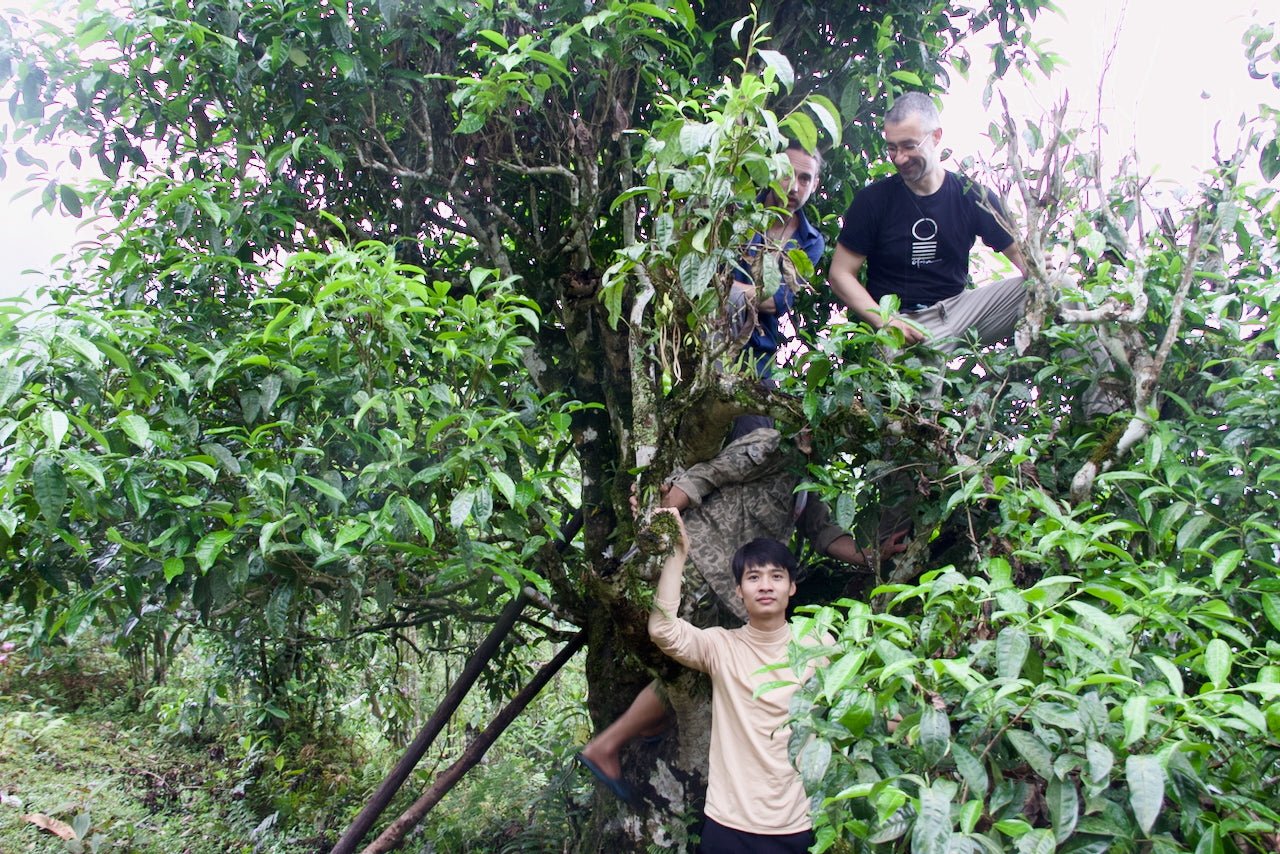
Northwest Vietnam is reminiscent of Yunnan, 20 year ago
A Land of Diversity:
Vietnam's long, S-shaped geography is not incidental to any of this — it's essentially the whole explanation. The country stretches across nearly 3,000 kilometres of latitude, and a remarkable amount of that length runs through cool, elevated terrain. Roughly three-quarters of the national tea area sits in the Northern Midlands and Mountainous region. The Central Highlands, particularly around Lâm Đồng and the Đà Lạt plateau, account for much of the rest.
In practice, this means diversity. From oolong teas that taste fairly similar to Taiwanese oolongs to ‘pu er’ like leaves from the North, it is very easy for most of us to find tea that we love. Add to that unique stuff like Dragon Claws and Silver Fairie (more on ‘weird’ Camellias below)…

Tea Here Is Older Than the Country.
In fact, it’s older that most modern nations!
Tea has been consumed in Vietnam for well over a millennium, shaped in part by cultural exchange with China, but quietly developing its own character along the way. China, Japan, and Korea eventually codified their tea practices into elaborate cultural forms — codified to varying degrees as ceremony, philosophy, or art. Vietnam seems to have taken a different path: tea is woven into daily life rather than elevated above it. It is what you drink when you sit down with someone. It's not complicated.
But the trees themselves predate all of that framing. The northern highlands of Vietnam, together with Yunnan, Laos, and Myanmar, are considered among the original homelands of *Camellia sinensis*. Long before anyone drew borders across these mountains, tea trees grew wild in the forests, tended — if at all — by the Hmong, Dao, and other ethnic communities who had lived alongside them for generations. Some of those trees are still there. Some of them are very, very old.

The Genetic Story Underneath It All
Beyond the familiar Camellia sinensis var. assamica and var. sinensis — which together account for the overwhelming majority of tea produced on Earth — Vietnam is home to wild Camellia species that most tea drinkers have never encountered. Camellia taliensis, shared with Yunnan, grows as ancient trees and produces a softer, less bitter liquor with complex aromatics. Camellia crassicolumna is rarer still, and (as far as we know), is native to Vietnam. The Vietnam Academy of Science and Technology has documented the significance of these wild populations for genetic conservation, and the case they make is a strong one.
These species matter not simply as curiosities. They are evidence that Vietnam sits at the centre of tea's origins — not at the periphery.

Mountain People Keeping Something Alive
The Hmong and Dao communities who tend these forests carry knowledge that isn't written down anywhere. When to harvest. How to judge a leaf by touch. How much wither is right for this particular day's humidity. This knowledge moves from person to person, generation to generation, and it is genuinely fragile. As younger people move to cities — as they do everywhere — and as commodity pressures push toward uniformity, the thread can break.
But something else is also happening. A growing number of small producers and younger tea makers are returning to these traditions, not out of nostalgia but out of conviction. They're working with old trees, reviving traditional processing methods, and connecting with international buyers who are willing to pay for provenance and quality rather than volume. We are very happy (and honoured) to be a small part of this.
The conversations happening now among Vietnamese producers about who they want to be in the global tea landscape are the same conversations that transformed other origin countries a generation ago. The difference is that Vietnam has something most of those countries didn't: trees that were ancient before anyone thought to write any of this down.

References:
Vietnam Tea Association (VITA) — Industry development, production figures, and quality initiatives. Data cited via B&Company: [Vietnam Tea Industry: Production Situation, Main Players, and Export Potential](https://b-company.jp/vietnam-tea-industry-production-situation-main-players-and-export-potential/) (March 2025)
B&Company — Market research and industry analysis: [Vietnam Tea Industry: Production Situation, Main Players, and Export Potential](https://b-company.jp/vietnam-tea-industry-production-situation-main-players-and-export-potential/) (March 2025)
Vietnam Academy of Science and Technology — Wild *Camellia* species and genetic conservation research
UNESCO — Vietnamese intangible cultural heritage and tea customs
Vietnam National Administration of Tourism — Regional tea culture
TeaTrade — Vietnam tea economy and terroir analysis
Alveus — Historical and cultural context
Academic and UN-supported tea industry data
Ethnographic observations and field visits, northern highland provinces
Comments