Hagi Yaki by Chōungama | Essential Japanese Pottery
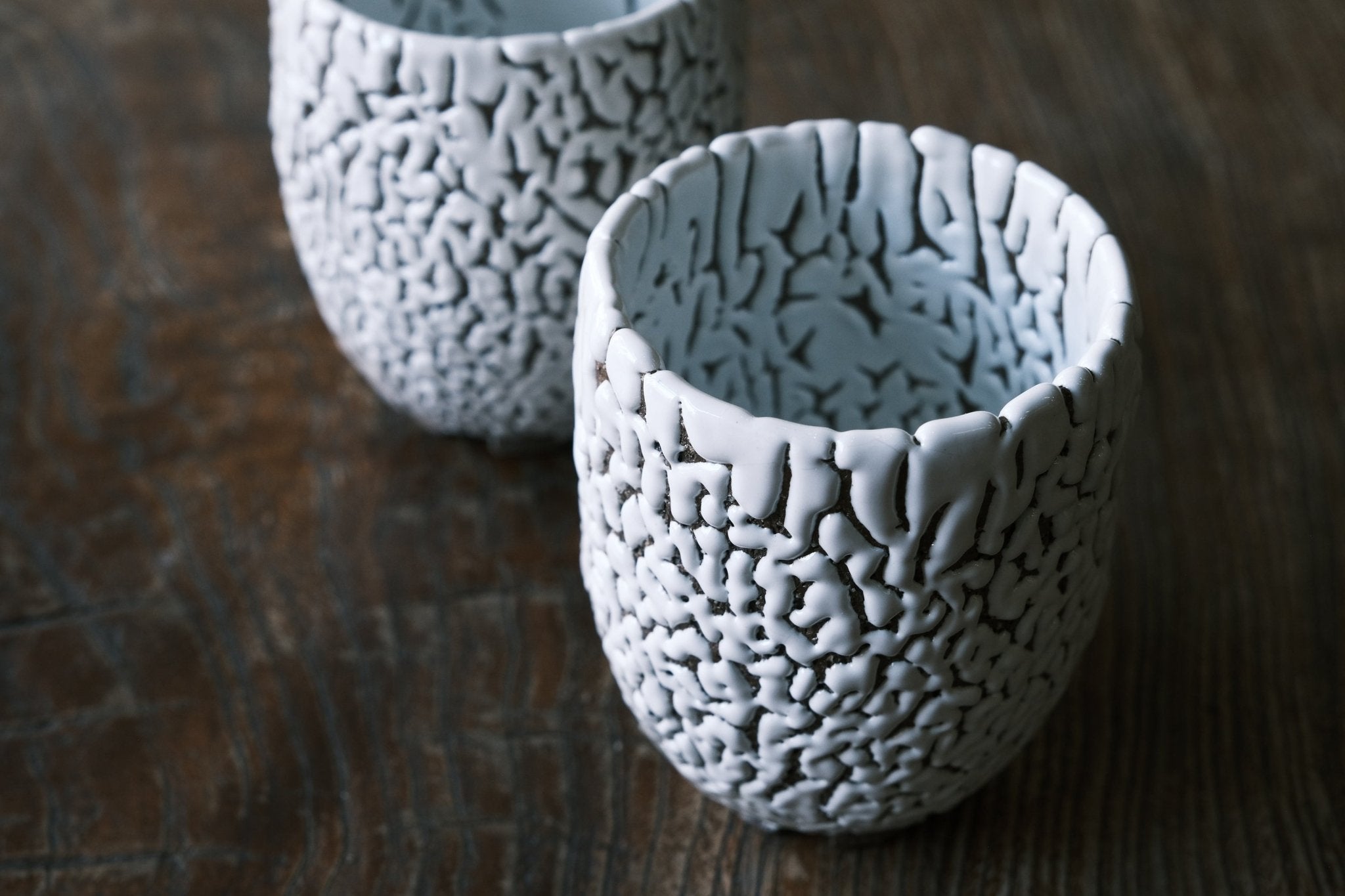
We've been fascinated by Japanese ceramics for a long time. How on Earth we had remained ignorant abou Hagi Yaki until this year... we can't explain. Starting this summer, thanks to Naoko San, we now have the pleasure of offering some stunning Hagi Yaki pieces at the tea bar.
In May this year we received an email from Sora Yung, a Vancouver born artist who is now based in Hagi. She kindly offered an introduction to Naoko San, third generation ceramic artist at one of Hagi's historic kilns Chōungama.
Soon after, Naoko San gifted me the most amazing summer chawan that became one of my favourite drinking vessels. And of course, this meant that a visit to the kiln was necessary.

What is Hagi Yaki
Hagi yaki (萩焼) is a style of stoneware from Hagi, in Yamaguchi Prefecture. It is a beautiful representation of Japanese aethetics featuring suble glazes and natural shapes.
Hagi Yaki is very famous among Japanese tea practitioners, second only to Raku. A really cool characteristic of this pottery is "nanabake" (see below): just like pu er tea, Hagi Yaki drinking vessels evolve through time and become ever more interesting.

History of Hagi Yaki
Hagi pottery's origin dates back to the end of the sixteenth century, in the aftermath of the Bunroku-Keichō War of 1592. Two Korean potter brothers, Lee Gwang and Lee Gye, were brought to Japan and invited by Mori Terumoto, the feudal lord of the domain. Their earliest pieces were close copies of Joseon-dynasty tea bowls. It took roughly 100 years for Hagi ware to become a truly distinct style.
The first recorded references about Hagi Yaki's changing nature came towards the end of the Kyōhō era, around 1716. Someone discovered that the local clay's pottery evolves significantly as it people use it.
What is Nanabake
Nanabake means "seven changes," and it describes the single quiet flaw that became Hagi ware's greatest feature: the glaze cracks. Those fine cracks, called kannyū, let tea and other liquids gradually seep into the porous body underneath the glaze. With every pot of tea, every rinse, every year of ordinary use, the bowl actually changes; the colour deepens from a pale, sandy beige toward warmer ambers and browns. The fine cracks becomes more pronounced.
That means a Hagi chawan is never a finished object when it leaves the kiln. Both you and your chawan will evolve through time, gaining wisdom (metaphorically for the chawan) and character. Two identical bowls, used by two different people, will look nothing alike after a decade. It's the perfect incentive to use your Hagi bowl, not preserve it in a cupboard.

History of Chōungama
The Notomi family's workshop, Chōungama, sits in the Tamae district of Hagi, where the local clay has been dug from the same hillsides for generations. The kiln name Chōun has passed from master to master within the family, most recently from Susumu Notomi's father — the kiln's second-generation Chōun — down to Susumu himself.

Susumu Notomi was born in 1951 in Hagi City. He studied engineering at Kanto Gakuin University and (by his own account) took a fairly ordinary path afterward: finishing school, getting a boring job.
But the pull of the clay he'd played with as a boy never really left him. He returned to Hagi to apprentice under his father starting in 1975, began working under his own seal a decade later, and formally inherited the name Chōun around his thirtieth year in the craft. He is now Sandai Chōun, the third generation.
Since then, Notomi-san has become a full member of the Japan Crafts Association, held solo exhibitions at Mitsukoshi and Takashimaya in Tokyo, Maruzen in Nihonbashi, and galleries as far as New York, and been selected repeatedly for the Japan Traditional Crafts Exhibition and the West Japan Ceramic Art Exhibition over a career now spanning more than four decades. In 2019, he received the Yamaguchi Prefecture Award for Meritorious Service in Arts and Culture.
Notomi-san is particularly fascinated with colour blue (aohagi, or "blue hagi"). This a cooler, more silvered tone was once part of old Hagi ware and had all but disappeared when Notomi-san was starting this path. It's a technically difficult effect to control, and reviving it has become something close to his signature.

Working alongside him is another incredibly talented aritst: his daughter, Naoko-San. Naoko balances her artistic life with the most beautiful family and mentorship of a small circle of students from further afield. Thank you also to Sora and Ellie (two of those students) for the introduction to Chōungama and a fantastic experience exploring the kiln.

Comments