Georgian Tea: Black Sea Origins, Wild Cultivars & A Modern Revival | O5 Tea
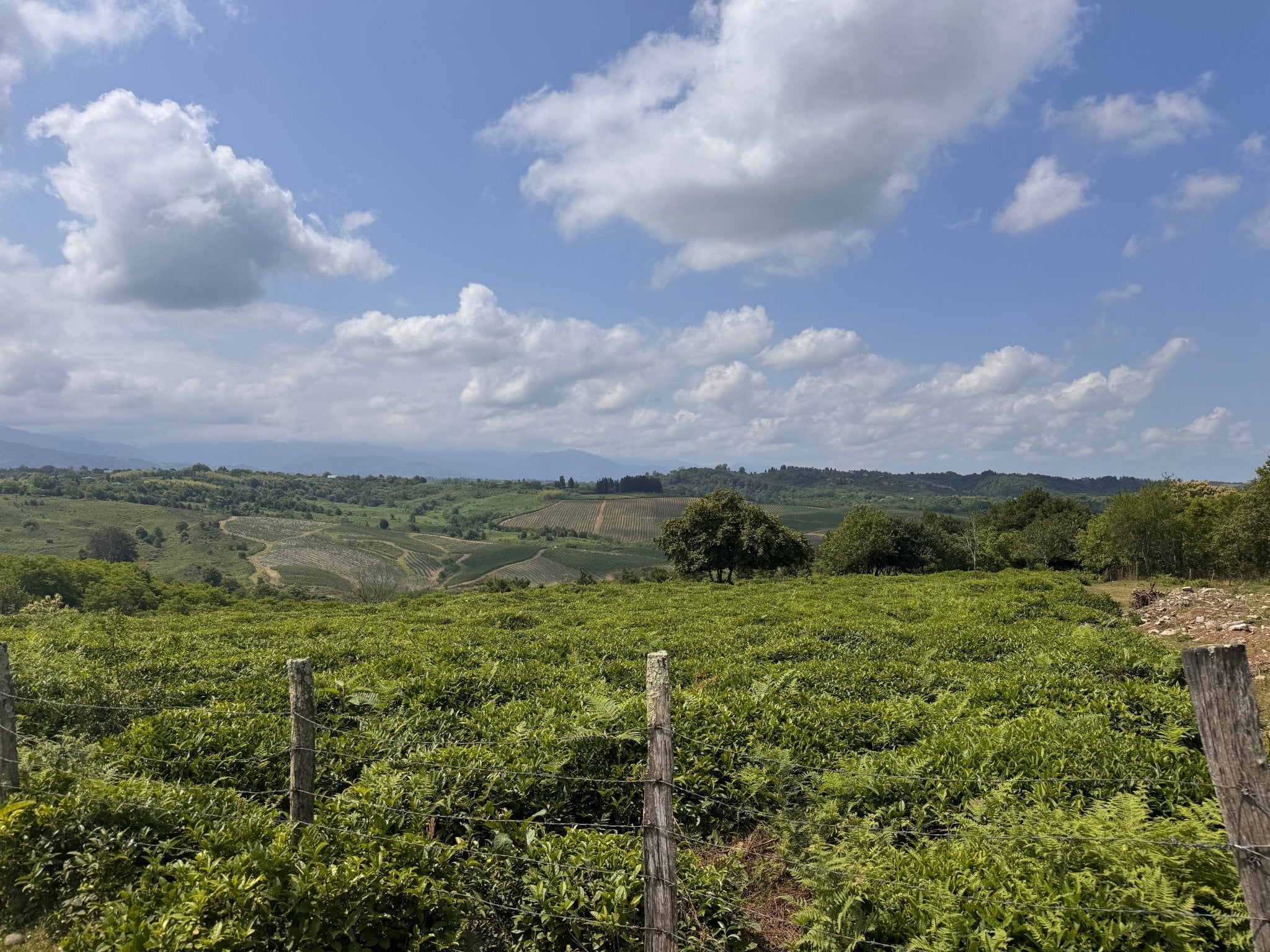
Discover tea in the Republic of Georgia!
We’re endlessly drawn to places that feel just slightly beyond the map’s edge—places where culture, language, landscape, and craft still retain a sense of mystery. That spirit of discovery is what led us in the summer of 2025 to the Republic of Georgia, and it paid off with some fantastic leaves to share at our tea bar.
The Republic of Georgia is a stunning country, nested by the Black Sea and located right where two continents collide. Our interest was first sparked by our good friend Martin Spimr of Tea Mountain in the Czech Republic. In a leaf exchange, Martin sent us some obscure leaves from Guria, and they immediately caught our attention—teas with the sweetness of northern Chinese black teas and peppery hints of Himalayan Camellia. Sometimes a single cup is enough to open a door, and this one opened onto an entire tea landscape we had barely begun to understand.

That first encounter also came with a humbling realization. It sparked an immediate Wikipedia search for Georgia; we’re not proud to admit that our knowledge of this fascinating country was quite basic. The more we learned, the more compelling Georgia became. Europe and Asia collide in Georgia, and while the continental divide may be an imaginary borderline, the cultural depth here is anything but abstract. Georgia has three writing systems—Asomtavruli and Nuskhuri, now used primarily in religious texts, and Mkhedruli, the script of modern Georgian life.

And what a history it is. Georgia was the first Western (European Christian) kingdom to clash with the Mongol Empire, standing at a dramatic intersection of empires, faith, and storytelling. These are the kinds of histories that give a place texture long before you arrive there. They also help explain why Georgia feels so singular—not merely a country between continents, but a place shaped by collision, endurance, and reinvention.
Then there are the gardens—and the people bringing them back to life. Meet Davit Tenieshvili, producer of fantastic tea and a true Renaissance man. Davit is among the leaders restoring tea gardens that are over 100 years old, while also harvesting from wild tea plants and handcrafting both black and white teas. And why are there so many wild tea plants? In a wonderfully Georgian twist, cows—abundant across the landscape—transport seeds in their hooves from tea gardens into the surrounding forests. Thanks to our bovine friends, wild tea plants now grow far beyond cultivated fields.

What makes those plants so expressive is the land itself. In western Georgia, a lesser-known tea landscape unfolds beneath the humid breath of maritime air. Regions such as Guria, Samegrelo, and Adjara form the ecological heart of Georgian tea cultivation, shaped by a humid subtropical climate, generous rainfall, and soils enriched by ancient forest ecosystems. Today, Georgian tea is experiencing a quiet but deliberate revival, led by small producers returning to hand-processing and organic cultivation. The resulting flavours—gentle, rounded, and subtly sweet—mirror the softened contours of the land itself. In many ways, this is a tea culture being rediscovered in real time.


One of the more fascinating aspects of Georgian tea lies in its plant material. Much of the existing stock traces back to Chinese varieties of Camellia sinensis introduced in the 19th century, selected for their cold tolerance and adaptability to humid subtropical conditions. Over time, these plants have naturalised, hybridised, and in some cases drifted into semi-wild populations. In abandoned gardens and forest margins, one encounters seed-grown bushes with remarkable variability—some expressing the soft, sweet profile of classic sinensis types, others showing broader leaves and more rugged structure. This genetic diversity is not just botanical—it translates directly into the layered, quietly complex character of modern Georgian tea.

The Soviet period, however, brought a very different approach. Driven by scale and self-sufficiency, Soviet scientists and agronomists developed breeding programs focused on high-yielding, frost-resistant cultivars suited to mechanisation. Research stations—particularly in Chakva—selected clones capable of producing large volumes of leaf under colder conditions. At the same time, industrial factories were built to process tea efficiently and uniformly. While this era transformed Georgia into a major global producer, it came at the cost of nuance. Today’s revival is, in many ways, a response to that legacy: a return to older plant material, smaller production, and a renewed sensitivity to flavour, texture, and place.

REFERENCES:
THE STORY OF GEORGIAN TEA: A HIDDEN GEM IN THE WORLD OF TEA.
Georgian Tea Makers. Read article
GEORGIAN TEA: RESURGENCE AND CULTURAL SIGNIFICANCE.
Georgia.to, 2025. Read article
GEORGIA TEA GUIDE.
Journal of Nomads, 2024. Read article
TEA HISTORY IN GEORGIA.
TeaWay. Read article
ORIGINS: BLACK SEA GEORGIAN TEA.
Tea Journey, 2019. Read article
GEORGIAN TEA: A FORGOTTEN TREASURE IN THE WORLD OF TEAS.
Red Fedora Diary, 2025. Read article
REVIVING GEORGIAN TEA: A JOURNEY FROM SOVIET GARDENS TO SPECIALTY BREWS.
Path of Cha, 2025. Read article
THE HISTORY AND REVIVAL OF GEORGIAN TEA: A TRADITION REBORN.
Tabatea, 2025. Read article
GURIAN TEA: REBIRTH OF TRADITION AND TRADE.
United Nations Development Programme. Read article

Comments