Xiaguan’s “Special Grade” tuo: an honest, affordable raw Pu Er to drink every day, or to stock up on and watch change over the years.
| Name |
Te Ji Tuo Cha 特级沱茶, “Special Grade” tuo |
| Producer |
Xiaguan Tuo Cha 下关沱茶, Dali, Yunnan |
| Type |
Sheng Pu Er (raw, 生) |
| Leaf |
Yunnan large-leaf, sun-dried mao cha 云南大叶种晒青茶
|
| Shape |
Tuo cha, 100 g or 250 g |
| Vintages |
2012, 2013 and 2014 |
| Storage |
Dry-aged in Richmond, BC since 2015 |
| Good for |
Daily drinking, stocking up, side-by-side tastings |
Why this tea
Te Ji means “Special Grade.” Xiaguan started making it in 2003 as a step up from its famous Jia Ji tuo, with a higher share of buds and young, tender leaf. It has been pressed every year since, which makes it one of the easiest ways to taste how one Xiaguan recipe changes from year to year.
It’s also simply good value. You can keep a few tuos open for everyday brewing and put a few more away without thinking too hard about it.
What to expect
This is classic Xiaguan: firm and lively, with some smoke. Next to the Jia Ji, the Te Ji is usually described as a little smokier, fruitier and sweeter. Young Te Ji can be bitter and brisk. With age, the smoke usually softens and the cup gets rounder.
Like all Xiaguan tuos, these are pressed hard, so give them a few infusions to open up.
Classic XiaguanSome smokeMore budsFirm structureDaily drinkerGood to age
Pick your tuo
100 g tuo
2012
The oldest of the group. The box in our photos is stamped with a production date of 7 May 2012.
Choose it for: the most age, or a first taste.
100 g tuo or bag of 5
2013
One year younger. Also sold as a bag of five, the way Xiaguan packs them.
Choose it for: everyday drinking, or stocking up.
100 g, bag of 5, or 250 g
2014
The youngest, and the only one also offered as a larger 250 g tuo.
Choose it for: putting away to age, or sharing.
Our suggestion: try one of each. They’re affordable enough. Then stock up on the one you like best, to age at home and share with friends in years to come. The bags of five cost less per tuo.
A tasting to try
1Three years, one recipe. Brew the 2012, 2013 and 2014 side by side with the same weight, water and timing. Look at the colour of the liquor first, then taste from youngest to oldest.
2Te Ji vs Jia Ji. Put a Te Ji next to our Jia Ji Tuo from the same year to taste what “Special Grade” actually changes.
Reading the packaging
Xiaguan packaging is full of small clues. Here’s what’s on these.
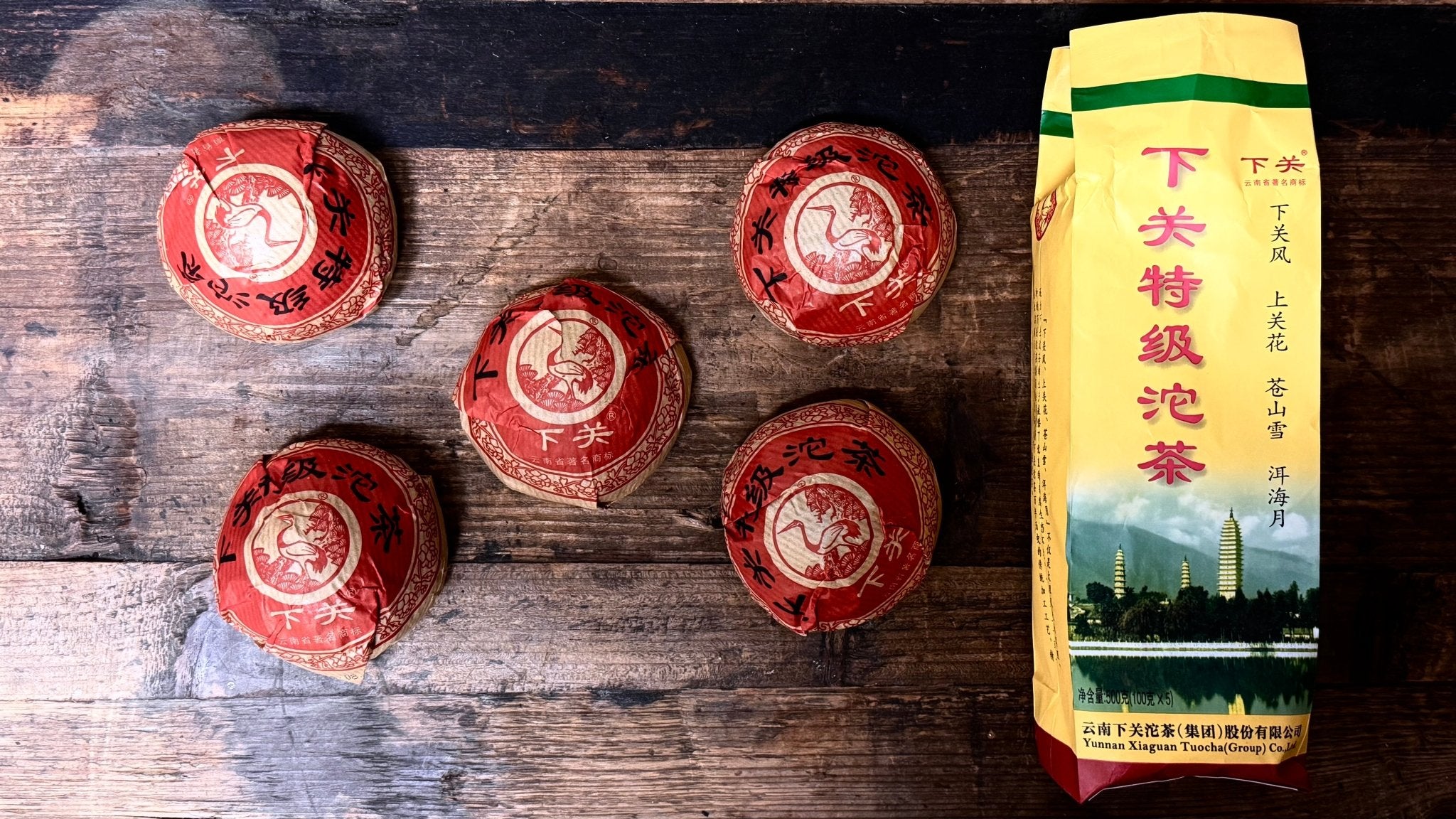
Name
下关特级沱茶
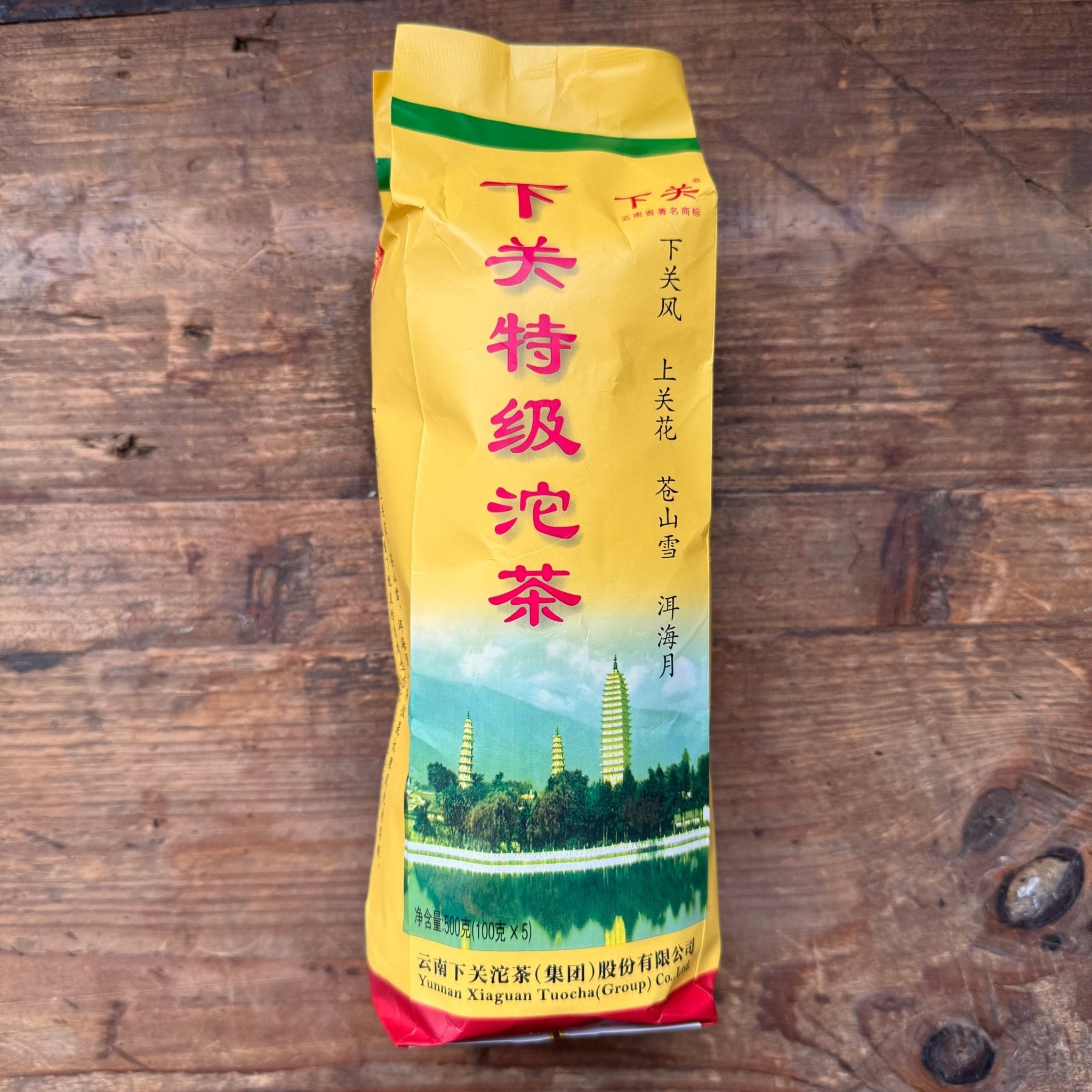
Xiaguan Te Ji Tuo Cha: Xiaguan Special Grade tuo tea. It’s on the red paper wrapper, the bag and the box.
Logo and motto
松鹤延年
The crane-and-pine (Song He) mark, with the old saying “pine and crane, long life” printed on the round box.
On the bag
下关风 · 上关花 · 苍山雪 · 洱海月
The four wonders of Dali: the wind of Xiaguan, the flowers of Shangguan, the snow of Cang Mountain and the moon over Erhai Lake. Under them, the Three Pagodas of Dali.
Standard
GB/T9833.5
China’s national standard for compressed tea. Part 5 covers tuo cha.
Production licence
QS5329 1401 0004
5329 is Dali Prefecture and 1401 is tea. QS numbers were replaced by SC numbers in 2015.
Raw material
云南大叶种晒青茶
Yunnan large-leaf, sun-dried green tea, the base of all raw Pu Er.
Shelf life
在符合贮存条件下,产品可长期保存
“Stored properly, this product keeps long-term.” Not every Pu Er label has said that. Older labels gave a short shelf life, and one account of the famous Xiaguan 8653 says its first batch was sold off cheaply partly because it had passed its three-year date.
Maker’s address
云南省大理市下关镇建设西路13号
No. 13 Jianshe West Road, Xiaguan, Dali.
Production date
2012.05.07
Stamped on the 2012 box: 7 May 2012.
What is a tuo?
A tuo 沱 is Pu Er pressed into a small bowl or bird’s-nest shape, with a hollow underneath. It’s the shape Xiaguan is famous for. The compact form travels well, stacks well and, because it’s pressed hard, ages slowly and evenly.
Richmond dry storage
These tuos have been in Richmond, BC since 2015. Our climate is cool and fairly dry compared with traditional Pu Er storage in Hong Kong, Guangzhou or Taiwan. The tea changes slowly and keeps its structure, so you get aged tea that still has plenty of energy.
How we brew it
Gong fu
- 6–7 g per 100 ml
- Water at a full boil
- Rinse once, then let the wet leaves rest 30 seconds
- Start with 8–10 second infusions
- Add time as the leaves open
Breaking a tuo
- Turn it over and start at the edge of the hollow
- Use a Pu Er pick and lift flakes along the layers
- Go slowly: Xiaguan tuos are pressed hard
- Freshly broken tea can taste closed; a few days in a jar helps
Tip: don’t judge it on the first cup. The second and third infusions are where a tight tuo starts to show what it has.
How to store it
Keep it in its wrapper, inside a clean Pu Er box or another odour-free space. Keep it away from strong smells, direct sunlight, heat, damp, and big swings in temperature or humidity. Don’t refrigerate it.
About Xiaguan
Founded in Dali in 1902, Xiaguan sent tea by caravan from Yunnan to Tibet and helped develop ripe Pu Er in the 1970s. Today it’s one of China’s best-known tea companies, and the tuo is still its signature. Read our Xiaguan story, or our visit to Xiaguan on the O5 Tea School blog.
More from O5: Xiaguan Tuo Cha · Pu Er · Aged & Collected