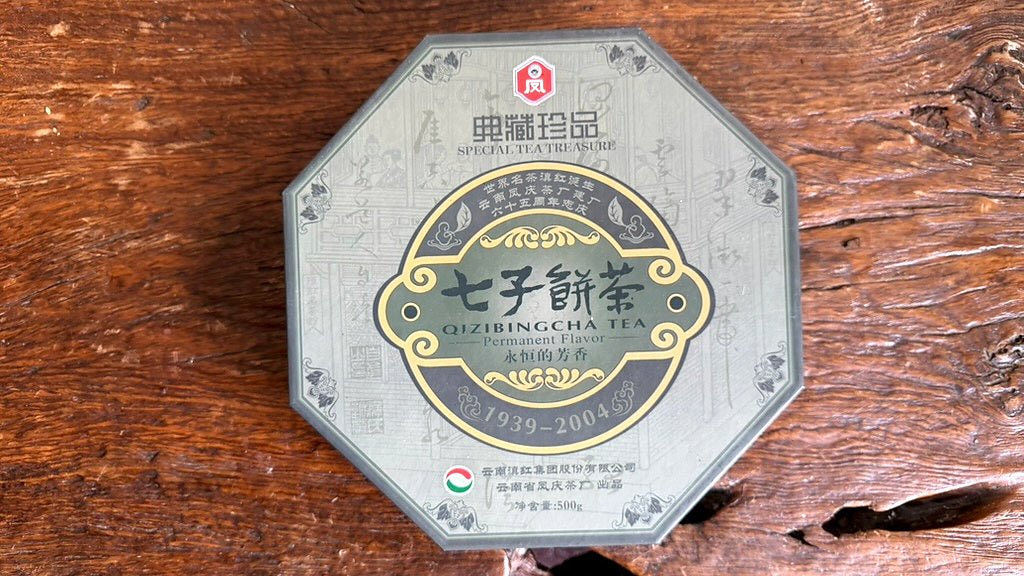
A beautifully dry-aged raw Pu Er, stored in British Columbia since 2014. This unusually large 500 g cake celebrates the Fengqing Tea Factory’s 65th anniversary, with a production date of 8 August 2004 printed on its packaging.
More than two decades after its production, this tea still has plenty of strength. The liquor is powerful and tasty to drink now, with the structure that makes us happy to keep some tucked away. In our assessment, it can comfortably age for another decade or two under suitable storage conditions.
Type: Raw Pu Er / sheng
Producer: Yunnan Fengqing Tea Factory / Dianhong Group
Origin: Fengqing, Lincang, Yunnan, China
Production date: 8 August 2004, as printed on the packaging
Cake size: 500 g — unusually large for a Pu Er cake
Storage: Beautifully dry aged; stored in British Columbia since 2014
Character: Powerful liquor, enjoyable now, with substantial aging potential
Edition: 65th factory-anniversary commemorative cake
A substantial cake with its history intact
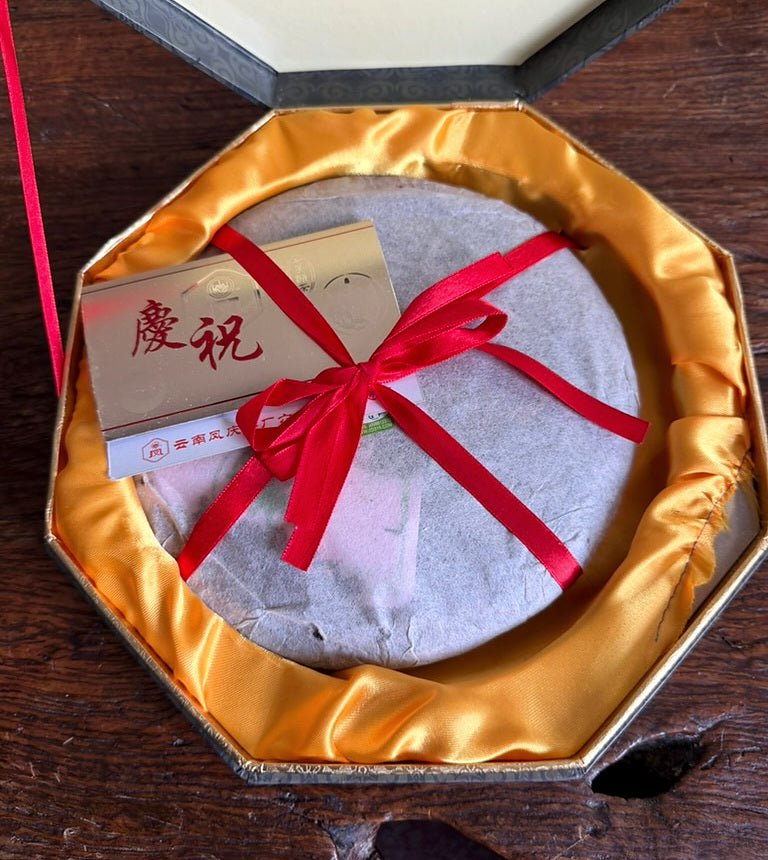
The grey-green, eight-sided presentation box opens to gold-coloured fabric and a red ribbon. The accompanying anniversary papers and numbered inner ticket preserve the story of the release. Across the cake’s surface, long, dark leaves are threaded with lighter buds.
At 500 g, this is a generous format: enough tea to return to over many sessions, share with friends, and follow as it continues to develop. Its appeal is both immediate and patient — open it for a strong cup today, or keep exploring its changes over the years.
Fengqing’s anniversary
Fengqing is closely associated with Dianhong, Yunnan black tea. Its factory history reaches back to the Shunning Experimental Tea Factory, established in March 1939 after Feng Shaoqiu’s development of Dianhong in 1938. That heritage explains the DIANHONG branding on this commemorative packaging. The tea inside is raw Pu Er.
A Chinese tea writer’s retrospective account also describes a 2004 Fengqing 65th-anniversary sheng cake. It provides useful corroboration of the release, although the writer remembers a six-sided box rather than the eight-sided presentation shown here.
The leaves behind the cake
The original insert describes a picking standard of one bud with two or three leaves, from tea trees described by the maker as wild in the forests of the Fengqing tea region. It also specifies high-temperature steam pressing. These are the original producer’s descriptions; the accompanying documents do not establish a specific garden, cultivar or tree age.
Brewing this powerful tea
Start gently: try 5 g per 100 mL in a gaiwan or small teapot, using 95–100°C water. Begin with short 10–15 second infusions and decant completely. Adjust the leaf quantity and steeping time to your taste. These are suggested starting parameters.
Give it room to unfold across successive infusions. There is no need to push a tea that already has this much strength.
Sources & provenance
-
Zhang Tao (former owner of Xiaguan Tuo Cha in Richmond) who kindly gave us access to a fantastic collection of aged pu er ta. Mr. Zhang imported this tea from his personal collection, along with a significant shipment of Xiaguan tea, in 2014.
-
Original packaging and photographs. Eleven photographs supplied by O5 document the 500 g weight, 8 August 2004 production date, anniversary presentation, producer names, leaf-material description and numbered ticket. The ticket photographed reads No. 3324.
-
Yunnan Department of Agriculture and Rural Affairs. 临沧凤庆红茶——从一杯香茗到百亿产业 (“Lincang Fengqing black tea: from a cup to a ten-billion industry”), 15 April 2026. Chinese; source credited to Yunnan Daily. Supports the 1938–1939 historical context.
-
PuerCP-hosted retrospective essay. 迷上普洱茶 梦中回临沧 (“Fascinated by Pu Er, returning to Lincang in dreams”). Chinese; publication date not established. Describes a 2004 Fengqing 65th-anniversary raw cake. This is a personal recollection, rather than factory authentication.


![O5 | TITANIUM GAIWAN [160ml] - O5 RARE TEA BAR](http://www.o5tea.com/cdn/shop/files/o5-titanium-gaiwan-160ml-7683949.jpg?v=1783556531&width=2048)
![O5 | TITANIUM GAIWAN [160ml] - O5 RARE TEA BAR](http://www.o5tea.com/cdn/shop/files/o5-titanium-gaiwan-160ml-448397.jpg?v=1750466831&width=2048)
![O5 |TITANIUM CUPS [180ml & 300ml] - O5 RARE TEA BAR](http://www.o5tea.com/cdn/shop/files/o5-titanium-cups-180ml-300ml-188904.jpg?v=1750466831&width=2048)
![O5 |TITANIUM CUPS [180ml & 300ml] - O-FIVE RARE TEA BAR](http://www.o5tea.com/cdn/shop/products/o5-titanium-cups-180ml-300ml-735558.jpg?v=1750451758&width=1280)
![O5 |TITANIUM CUP + INFUSER [200ml] - O5 RARE TEA BAR](http://www.o5tea.com/cdn/shop/files/o5-titanium-cup-infuser-200ml-5324885.jpg?v=1783142231&width=2048)
![O5 |TITANIUM CUP + INFUSER [200ml] - O5 RARE TEA BAR](http://www.o5tea.com/cdn/shop/files/o5-titanium-cup-infuser-200ml-4111703.jpg?v=1783142232&width=1538)
![O5 | TITANIUM KETTLE + TEA STRAINER [750ml] - O5 RARE TEA BAR](http://www.o5tea.com/cdn/shop/files/o5-titanium-kettle-tea-strainer-750ml-3635656.jpg?v=1779247987&width=2048)
![O5 | TITANIUM KETTLE + TEA STRAINER [750ml] - O5 RARE TEA BAR](http://www.o5tea.com/cdn/shop/files/o5-titanium-kettle-tea-strainer-750ml-641576.jpg?v=1750466592&width=2048)