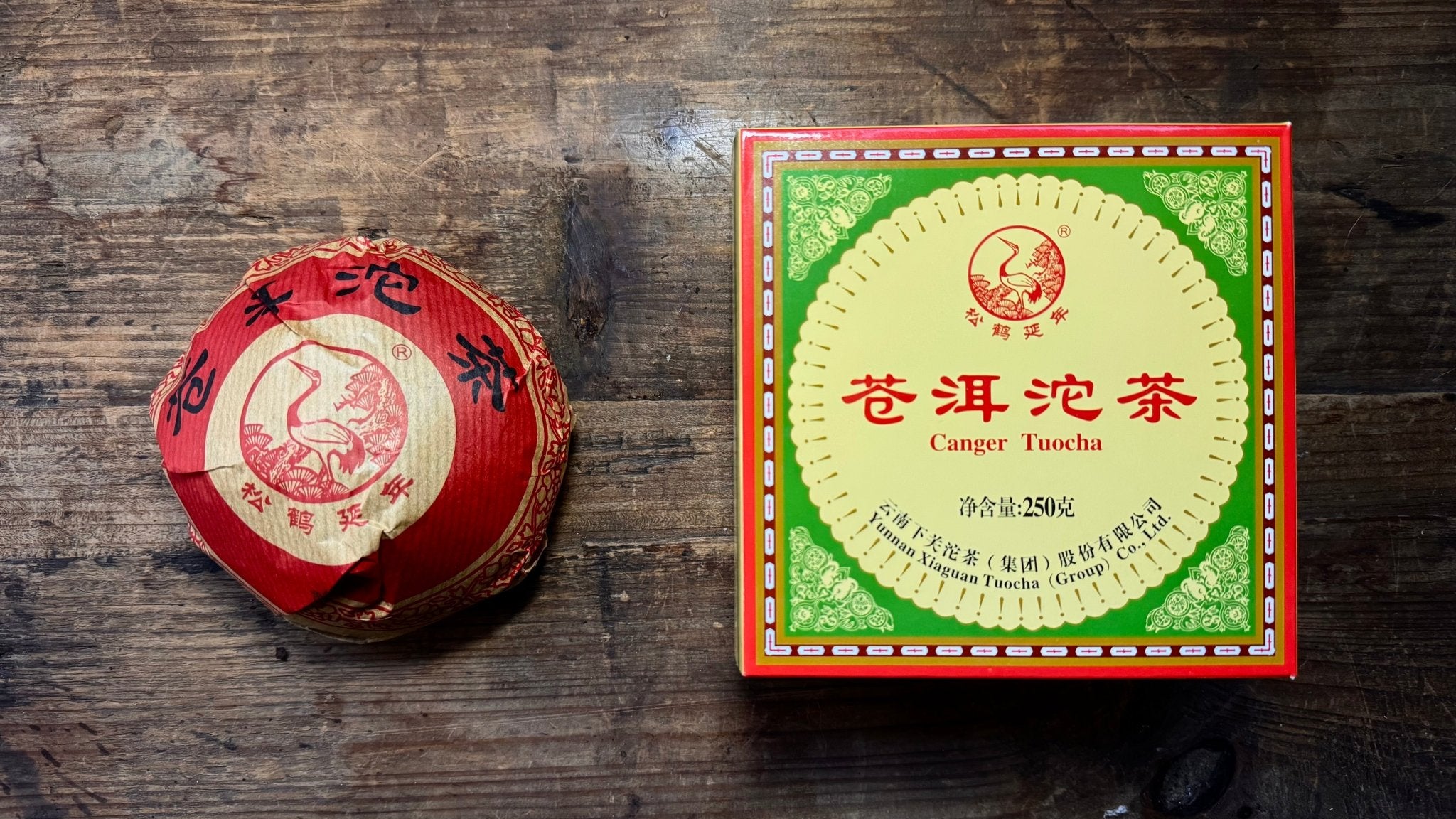
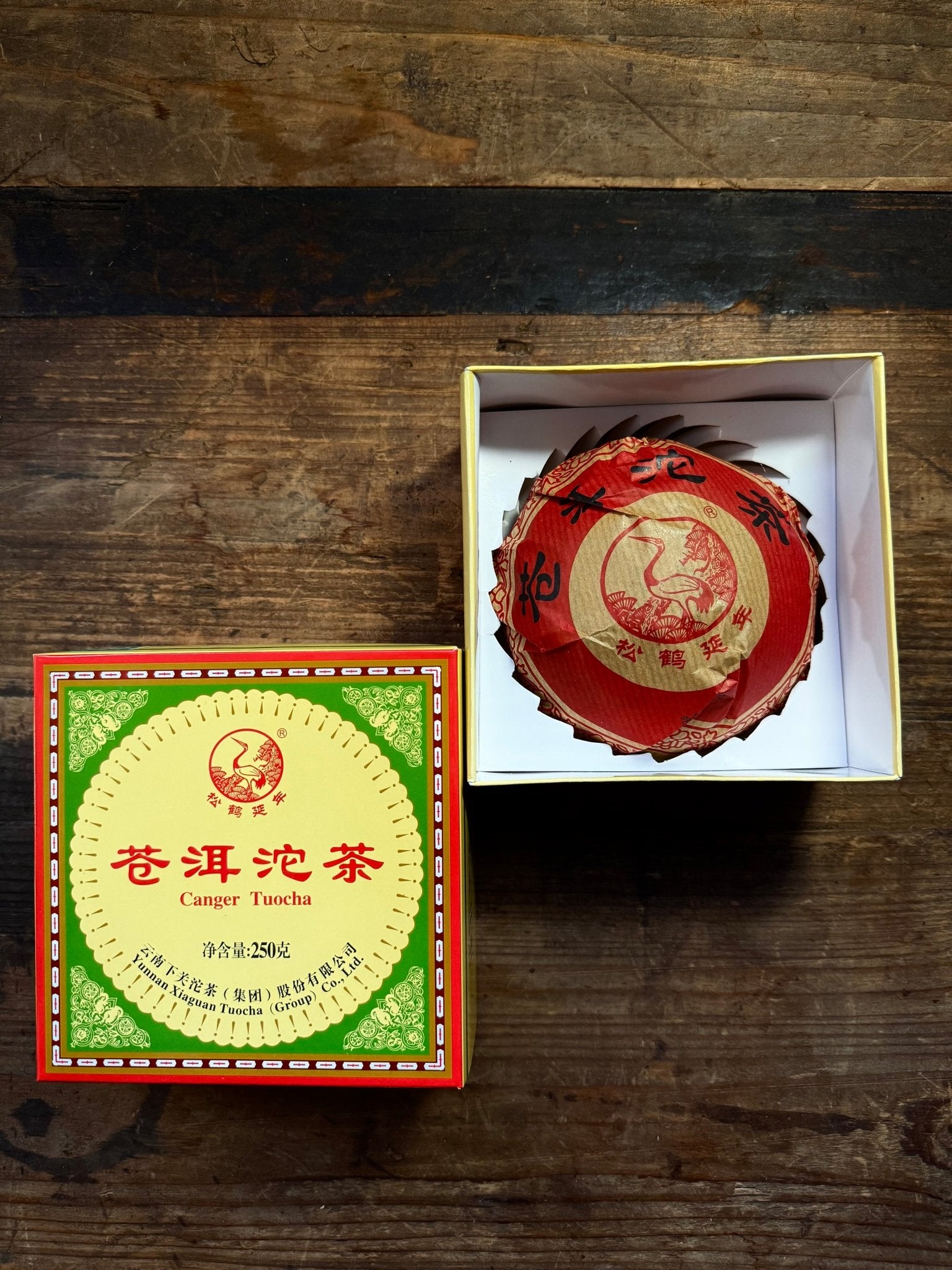
Xiaguan Tuocha's Canger iconic series is one of the most recognizeable brands in the pu er tea universe. Its identity is built on consistency, affordability, and a very distinctive flavour profile that makes Xiaguan unlike any other tea brand.
Enter a time machine! We are extremely fortunate to have a wide diversity of vintages of this iconic tea. These have been aging in Richmond (British Columbia) since 2014. Previously, they were stored in Kunming, Yunnan. This quite affordable tea line gives us a fantastic opportunity to study the development of tea leaves across time.
Please note that some of the older boxes are a bit crushed, as you would expect from tea that's been stored 2.5 decades.
Chinese Name: 苍洱沱茶 (Cāng Ěr Tuóchá). This recipe was originally created in 1959 as a national gift tea for the 10th anniversary of the PRC, named after Cangshan Mountain (苍山) and Erhai Lake (洱海) in Dali. Production was later discontinued, then revived in October 2000 under the Songhe trademark. It is classified as 金品 (Jinpin) series — entry-to-mid everyday tier — using plantation-material (台地茶) large-leaf spring maocha from Baoshan and Simao regions, steam-pressed with Cangshan mountain spring water.
Key Characteristics: expect an untiring, charming workhorse, not a single origin super refined tea.
-
The "Xiaguan Flavour" (下关味, Xiàguān Wèi):
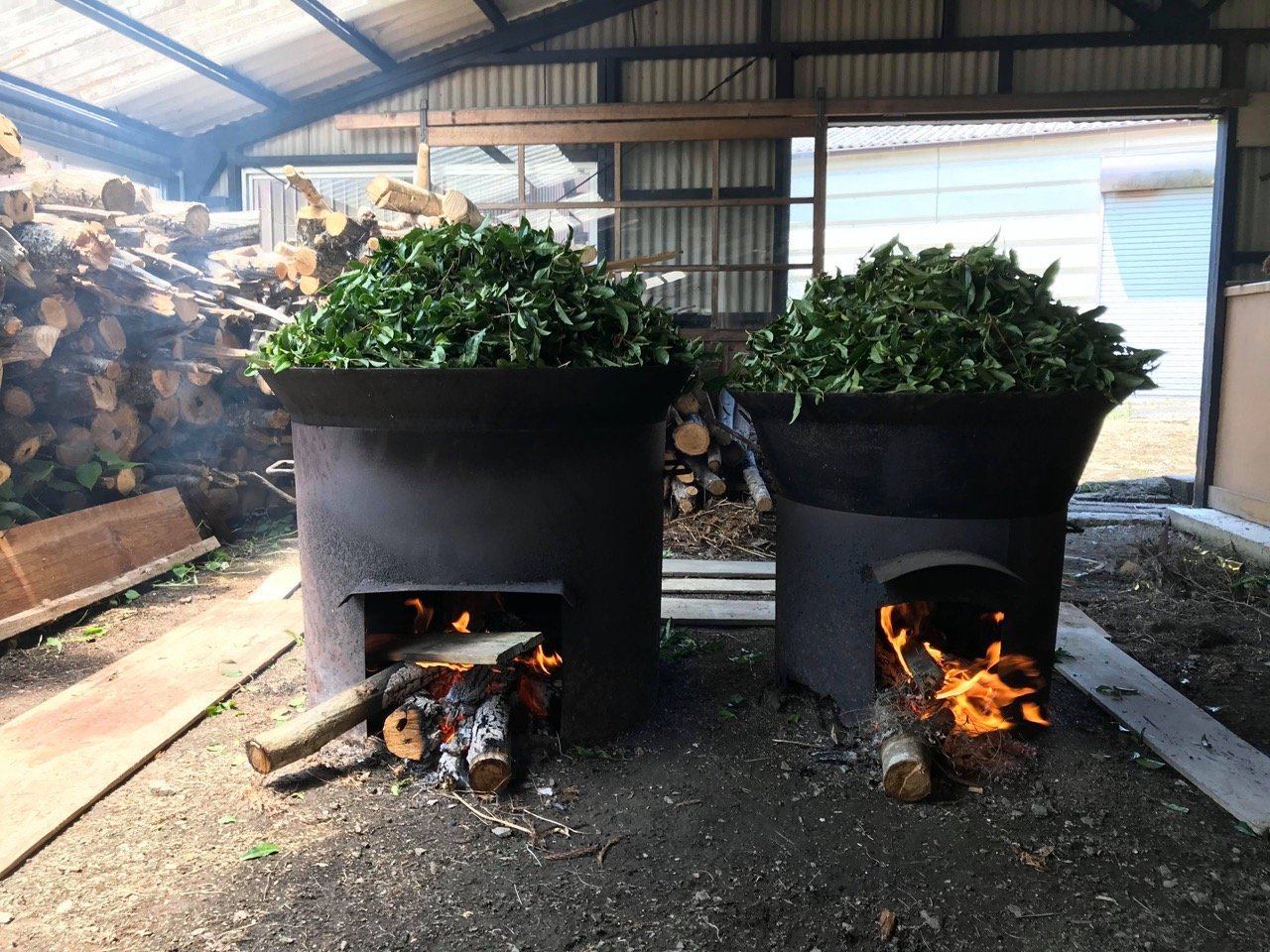
Not for the faint of heart: robust, straightforward, lightly smoky.
-
Recipe: Simao (思茅) and Lincang (临沧) region tea leaves.
- Picking Standard: primarily broken leaves and tips (碎茶, Suì chá). The use of broken leaf allows for a faster fermentation and a stronger, quicker-infusing brew.
-
Shape: tuo cha* (沱茶), a bowl-shaped compressed tea
-
Compression: notoriously tight. This protects the tea during transport but slows down the aging process.
Tasting Journey (2003):
Early infusions (1-3): Amber to orange-yellow liquor, bright and translucent. Mild smoke on the nose ('classic' Xiaguan — "无烟不下关"), honey-sweetness and camphor.
Mid-infusions (4-10): Liquor deepens to golden-amber, honey notes persist with floral hints; 'gan' deepens and lingers.
Late infusions: lingering, forest mouthfeel.
About Xiaguan Tuo Cha
The roots of the Xiaguan Tea Factory trace back to 1902, when the Yong Chang Xiang (永昌祥) merchant housein Xiaguan — the key trading hub on the Ancient Tea Horse Road — refined the bowl-shaped tuocha form that would become the factory's signature. As trade flourished, dozens of tea enterprises proliferated in the Xiaguan district of Dali throughout the 1910s–1930s.
The modern factory traces its official founding to May 1941, when the Mongolian and Tibetan Commission and the Yunnan China Tea Trading Company jointly established the Kang Zang Tea Factory (康藏茶厂). Its primary mandate was producing compressed tea for Tibetan markets under the 宝焰牌 (Baoyan / Holy Flame)trademark. After nationalization in 1950, the factory was renamed the Xiaguan Tea Factory and absorbed allremaining private tea houses in the Dali region by 1955.
Key milestones include: the 1959 creation of 苍洱沱茶 as a national anniversary gift tea; the 1972 creation of the Xiao Fa Tuo (小法沱) for French export — the first Pu-erh to reach Europe; national silver quality awards in 1981 and 1987; and the 1987 World Food Gold Crown Award in Düsseldorf. The factory restructured into a joint-stock company in 1994, then completed full privatization in 2004.
The company is regarded as one of China's "Big Three" legacy Pu-erh producers alongside Menghai Tea Factory (大益) and Kunming Tea Factory. The industry saying is: "勐海圆、下关沱、昆明砖" — 'Menghai for cakes, Xiaguan for tuochas, Kunming for bricks.' Xiaguan holds three major trademarks: 松鹤牌 (Songhe) for tuochas, 宝焰牌 (Baoyan) for bricks/cakes, and 南诏牌 (Nanzhao) for premium lines.



![O5 | TITANIUM GAIWAN [160ml] - O5 RARE TEA BAR](http://www.o5tea.com/cdn/shop/files/o5-titanium-gaiwan-160ml-7683949.jpg?v=1783556531&width=2048)
![O5 | TITANIUM GAIWAN [160ml] - O5 RARE TEA BAR](http://www.o5tea.com/cdn/shop/files/o5-titanium-gaiwan-160ml-448397.jpg?v=1750466831&width=2048)
![O5 |TITANIUM CUPS [180ml & 300ml] - O5 RARE TEA BAR](http://www.o5tea.com/cdn/shop/files/o5-titanium-cups-180ml-300ml-188904.jpg?v=1750466831&width=2048)
![O5 |TITANIUM CUPS [180ml & 300ml] - O-FIVE RARE TEA BAR](http://www.o5tea.com/cdn/shop/products/o5-titanium-cups-180ml-300ml-735558.jpg?v=1750451758&width=1280)
![O5 | TITANIUM KETTLE + TEA STRAINER [750ml] - O5 RARE TEA BAR](http://www.o5tea.com/cdn/shop/files/o5-titanium-kettle-tea-strainer-750ml-3635656.jpg?v=1779247987&width=2048)
![O5 | TITANIUM KETTLE + TEA STRAINER [750ml] - O5 RARE TEA BAR](http://www.o5tea.com/cdn/shop/files/o5-titanium-kettle-tea-strainer-750ml-641576.jpg?v=1750466592&width=2048)
![O5 |TITANIUM CUP + INFUSER [200ml] - O5 RARE TEA BAR](http://www.o5tea.com/cdn/shop/files/o5-titanium-cup-infuser-200ml-5324885.jpg?v=1783142231&width=2048)
![O5 |TITANIUM CUP + INFUSER [200ml] - O5 RARE TEA BAR](http://www.o5tea.com/cdn/shop/files/o5-titanium-cup-infuser-200ml-4111703.jpg?v=1783142232&width=1538)